

When Two Bearings Pull
He sat across from me with pain on his face and asked me a question I hadn't expected.
"Mike, how do you think I am perceived by my peers?"
I had known Matt for a while by then. Smart, competent, thorough. Everything in his world was black and white, right or wrong, and he could defend every position he held with absolute conviction. He ran the fleet operation for the company and was responsible for every vehicle and piece of equipment across four branches in an industry that ran entirely on transportation and machinery. He was good at it.
But he had a blind spot the size of his entire peer group.
He didn't know it yet. That was the problem.
I knew the honest answer to his question. I had seen it from the outside for a while. His relationships with his peers were transactional at best. He only engaged with them when there was a problem to solve or a decision to enforce. He hadn't invested in any of them as human beings. Didn't know their spouses' names. Didn't know their kids. Didn't know what kept them up at night or what they were proud of.
The result was predictable. He was respected for his competence and quietly resented for everything else. The branch managers he served saw him as someone who made decisions that affected their teams without understanding the consequences. A competent person who had no interest in their world unless it intersected with his.
He was viewed as competent and confident. But also as arrogant.
And he was sitting across from me asking me to tell him the truth.
There's a moment in conversations like that one where you feel two things pulling at the same time.
The first is the pull toward honesty. He asked directly. He deserved a direct answer. Softening it enough to protect him from the sting would have been a disservice dressed up as kindness.
The second is the pull toward care. He had pain on his face before I said a word. Whatever was prompting the question had already cost him something. The honest answer was going to add to that cost before it reduced it.
Most of the time, leaders choose one or the other. They deliver the honest answer without the human warmth and it lands like a verdict. Or they soften it enough to protect the relationship and the message never actually lands.
I didn't want to do either one.
So I told him the truth.
"Matt, you are seen as extremely competent and also as confident. But you are also viewed as kind of arrogant. You treat your peers as people who bring you problems that you believe they created. Why should any of them care about what goes on in your world when they know you are completely uninterested in what goes on in theirs?"
He went quiet.
Then I asked him a question. Did he know anything about those peers beyond their job titles? Their spouses' names? Whether they had kids?
He didn't.
I told him that if he wanted a different kind of relationship with them, he was going to have to invest in it. Not check a box. Not solve a problem and move on. Actually invest. Ask questions to gain perspective before making decisions that affected their teams. Learn who they were before expecting them to trust his judgment.
That was the professional conversation. It took about twenty minutes.
What followed took two more hours.
Because somewhere in the questions I was asking, something else started to surface.
Every answer he gave me was technically complete but felt incomplete. Like there was more underneath it. As I listened, I began to see that the stated problem wasn’t the real problem. I could feel it. I could hear it in his tone, the hesitation, and the strong emotion he was expressing. So, I kept asking. Not because I had a plan for where it was going, but because something in his responses kept pulling me forward.
And eventually we arrived somewhere I hadn't expected.
He told me things that afternoon he had probably told fewer than a handful of people in his entire life. About where the rigidity came from. About what it had cost him. About a childhood that had taught him that black and white thinking was survival, not limitation. That being useful was where his value came from.
At one point, he stopped talking for a while. Whatever was sitting underneath of it had been there for a long time.
And I sat with it.
Not because I had a coaching framework in mind. But because I was moved that he trusted me enough to go there, and hopeful because every answer he gave revealed something that made me believe things could turn around for him. As long as I was honest and caring in the same moment.
That's the tension. Not honesty versus kindness. Not truth versus relationship. The tension is holding both at full strength simultaneously, without letting either one soften the other, for as long as the conversation requires.
About a week later, he walked back into my office.
He told me that one conversation had given him more honest, useful feedback than he had received from anyone in his entire life.
Then he told me the names of two of his peers' spouses. And how many kids each of them had. They were the two he had interacted with in the week since we talked.
Over the next six months, his peer relationships turned around. Not because I gave him a framework or a process. Because he started asking questions instead of issuing verdicts. Because he started investing in the people around him instead of managing the intersection points.
He became a different colleague. And somewhere along the way, a happier person.
Here's what I've come to understand about the moments when two bearings pull at the same time.
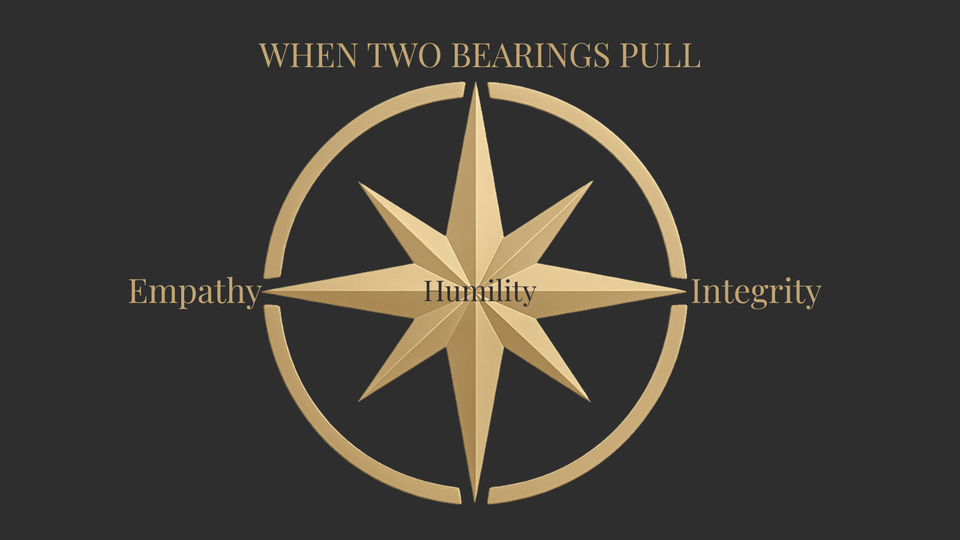
The Compass doesn't eliminate that tension. It never promised to. What it does is give you a way to stand inside it without collapsing toward the easier side.
Integrity without Empathy produces truth that wounds without healing. Empathy without Integrity produces comfort that protects the present at the cost of the future.
What Matt needed that afternoon wasn't honesty or kindness. He needed both. Delivered from the same place, at the same time, without one apologizing for the other.
That's what the Humility axis actually makes possible. I’ve seen leaders use Integrity as an excuse to stop caring how the truth lands. I’ve also seen leaders use Empathy as an excuse to avoid saying what needs to be said. Both allow the leader to feel justified. Neither fully serves the person sitting across from them.
When the focus is genuinely on the other person, on what they need rather than how you look delivering it, then the tension between bearings stops feeling like a conflict and starts feeling like a responsibility.
You hold both because the person in front of you deserves both.
Not one or the other.
Both.
So the question worth sitting with is this.
Where are you choosing one bearing and calling it leadership, when the person in front of you is asking for two?
Where are you being honest without being caring?
Or caring without being honest?
And what is that costing the person on the other side of the conversation?
Member discussion