

Embrace the Pause
I was at 155 feet when I almost killed myself.
Not dramatically. Not in a way that announced itself as danger. In the quietest, most reasonable-feeling way possible.
That's the part worth understanding.
It was Curaçao, about twelve years ago. My wife and I were there on vacation, but I also had open water dives to complete for four specialty certifications in Wreck Diving, Navigation, Stress and Rescue, and Deep Diving. On this particular day, it was just me and my divemaster, Daan. She was exceptional. We still stay in touch.
Before we even got in the water, she pulled out a slate. She had me sign my name and solve a math problem. Simple enough. She told me we were going to do it again at depth so I could see what 155 feet does to your thinking.
We waded in, swam out to the reef on the surface, and descended the wall. At depth, she handed me the slate again. I signed my name. Solved the math problem. Neither one gave me much trouble, and I remember feeling quietly proud of that.
We finished the structured exercises and had a few minutes left to swim around. That's when I noticed something wrong.
My regulator didn't seem to be giving me enough air.
I adjusted the flow. It didn't help. I adjusted it again. Worse. My breathing was picking up and the regulator wasn't keeping pace. The feeling of not getting enough air was building into something harder to manage.
And then a thought arrived.
It felt completely reasonable.
The regulator was obviously the problem. If I took it out of my mouth, I could take a really deep breath and get the air I needed.
One part of my brain constructed that solution with total confidence. Another part of my brain knew something was wrong with it but couldn't quite say what. Just a vague resistance. A signal without language.
I started to reach up with my right hand toward the regulator.
My left hand grabbed my right and pulled it away.
I didn't decide to do that. I just felt complete confusion. I wasn't sure what I was doing or why. Both hands just sat there for a moment while my brain caught up.
And then it caught up.
If I pulled out the regulator, there was nothing to breathe at 155 feet except water. The reasonable-feeling solution was the one that would kill me.
Initial crisis averted. But I was still nearly hyperventilating, still convinced something was wrong, still not getting enough air.
I needed to think. And the only way I was going to think was to clear out the noise first.
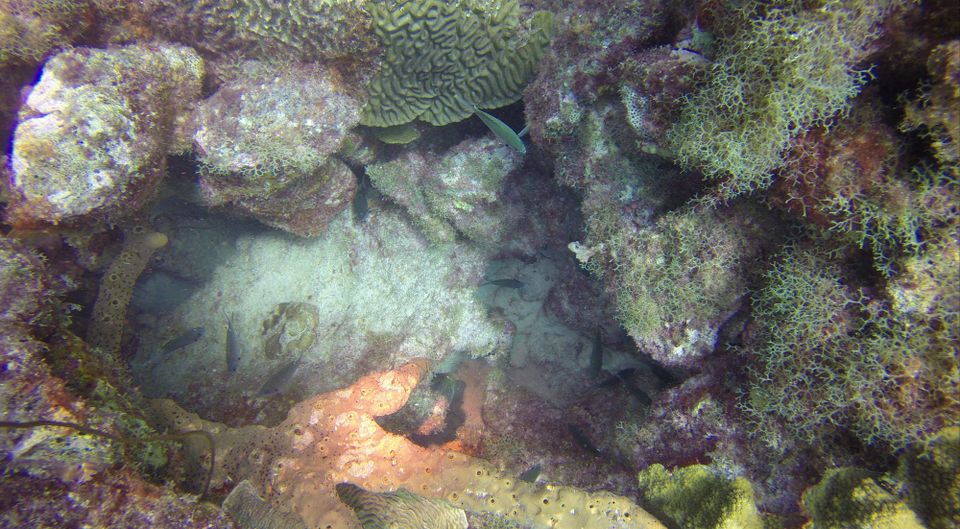
So I moved close to the reef wall and found a small piece of coral. I got my mask about four inches from it and I looked at it. The structure. The color. The texture. I didn't move. I didn't look around. I just looked at that piece of coral for thirty or forty seconds and let everything else go quiet.
The panic began to fade. My breathing slowed. And when it did, I realized the regulator had been working perfectly the entire time. I drifted back from the wall, found Daan, and finished the dive without another problem.
When we reached shore, she asked me what was so interesting about that piece of coral. I told her the truth. She said I had handled it perfectly. I had been experiencing nitrogen narcosis, a condition caused by breathing compressed nitrogen at depth. The dangerous thought feels reasonable. The bad solution feels like the obvious answer. You don't feel impaired. You feel like you've finally figured it out.
But even while narced, I had done exactly the right thing.
I passed.
I've thought about that dive many times since then. Not because it was dramatic. From the outside, it probably looked like a student getting unusually close to some coral. But from the inside, something happened at 155 feet that I've come to understand as one of the most important principles I carry as a leader.
I used to think the lesson was about diving. It wasn’t. The lesson wasn’t what happened underwater. It was what happened in the thirty seconds before I acted.
The pause that separated panic from clarity.
Nitrogen narcosis does to your judgment underwater what unmanaged pressure does to your judgment in a boardroom. Fear builds. Urgency rises. Expectation presses in. And somewhere in the middle of all of it, a thought arrives that feels completely reasonable. Move fast. Decide now. Do something.
The bad choice doesn't announce itself as bad. It arrives as the obvious answer, the solution that makes sense given the pressure you're feeling. And you don't feel impaired. You feel like you're finally getting clear.
That's the moment that requires the pause. Not because pausing feels right in that moment. It almost never does. But because the pause is what creates the conditions for your better judgment to surface before your panicked judgment acts.
Embrace the Pause is the decision to stop in that moment. The Anchor is how you do it.
At 155 feet, my Anchor was a piece of coral four inches from my mask. Thirty seconds of narrow focus. Everything else blocked out until the noise settled and something clearer could surface. In leadership, the Anchor looks different for every person and every situation. A walk around the building. A conversation with someone you trust. Sitting with a decision overnight before responding. The mechanism matters less than the commitment to use it. To stop before acting when pressure is manufacturing urgency that your judgment hasn't caught up with yet.
My left hand grabbed my right before I understood why. That's what the Anchor does. It doesn't wait for clarity. It creates the conditions for clarity to arrive.
I didn't name it that day on the beach in Curaçao. Daan thought she was watching a student handle narcosis correctly. She was right. But I was also watching something else take shape, a principle that had been true in my leadership long before I had language for it.
Embrace the Pause. Not as a slogan. Not as advice to slow down in general. As the specific, practiced discipline of stopping before acting when pressure is manufacturing urgency that your judgment hasn't caught up with yet.
Getting it right is much better than getting it right now.
Your left hand knows that.
The question is whether you'll listen to it before your right hand reaches for the regulator.
Member discussion