

The Small Does Not Stop
In 1914, men climbed into trenches across Northern France and Belgium and began a war that would consume four years and millions of lives. The conditions were brutal. Artillery. Mud. Cold. Death on both sides of the wire.
And yet they played cards. They passed around newspapers. On quiet nights, they sang songs to the men in the trenches on the other side.
Not after the war. During it.
Trevor Noah, in his Netflix special Joy in the Trenches, draws from this history to make an observation that sounds simple and lands like something much more profound:
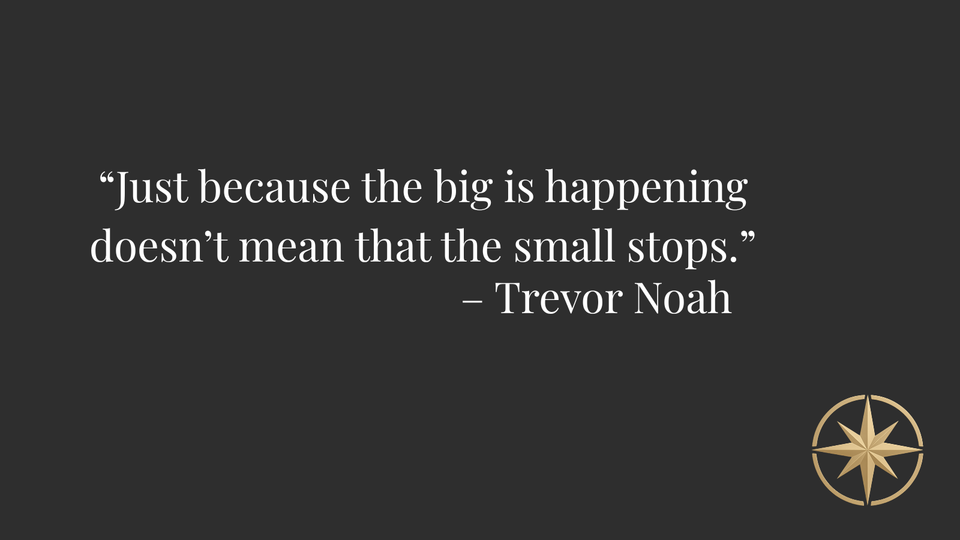
"Just because the big is happening doesn't mean that the small stops."
Most people who hear that line nod and move on. They shouldn’t.
Because what Noah is describing isn't just a coping mechanism. It's a truth about what it means to stay human and what it means to lead when everything around you is demanding that you become something smaller.
When something big arrives in an organization, it has gravity. A major system change. A restructuring. An acquisition. A crisis. It pulls everything toward it. Meetings multiply around it. Energy collapses into it. And leaders, almost without noticing, begin to close the door.
I know because I did it.
When our company was acquired by private equity, the first year was relatively quiet. We were the first acquisition of a new rollup entity and not much changed on the surface. But eventually, things began to shift. New software. New incentive structures. New policies. And the first big one, the software implementation, hit everything I was responsible for as Vice President of Operations. How we proposed work. How we logged time and materials. How we invoiced and collected. All of it.
So I went in. Completely. To the exclusion of everything else.
My door was always closed. My head was always down. And nobody bothered me.
Not because they didn't need me. But because they knew I was working on something big.
And things slipped.
Relationships slipped. Morale slipped. Performance slipped. Not dramatically, not all at once, but steadily, quietly, the way things slip when no one is paying attention.
Because I wasn't.
I had told myself, without ever saying it out loud, that the small could wait. That once we got through the big, we'd get back to everything else.
But the small doesn't wait. It keeps happening. And when it goes unattended long enough, it becomes something you can't easily recover from.
I would do that differently today.
It would be easy to read this as a lesson about balance or prioritization. It isn't. You cannot schedule your way out of this problem.
The antidote runs deeper. It lives in three places on the Compass.
Humility is what allows you to recognize that your big does not suspend other people's humanity. The leader who disappears into the crisis has, quietly, placed themselves at the center of the story. Their project. Their urgency. Their burden to carry. Humility pulls you back out. It reminds you that the people around you are still living their lives, still navigating their own fears, their own questions, their own need to be seen, regardless of what's on your desk.
Empathy is what keeps you looking. It's the active practice of noticing the small even when the big is loud. You cannot see what someone needs if you've stopped scanning for it. Empathy doesn't require hours. It requires presence. A door that opens. A name remembered. A moment acknowledged. Those things cost almost nothing to give and mean more than most leaders realize.
Purpose is the anchor that explains why any of this matters. If your purpose is genuinely about people, their growth, their dignity, their ability to do meaningful work, then the small is never actually small. It is the whole point.
And here is the harder truth: Purpose protects you from the gravitational pull of the big in the first place. When you are clear on why you are leading, you don't lose the small as easily. It is the leaders whose purpose has drifted, or was never fully formed, who get swallowed.
The gravitational pull of the big is real, and it is not a character flaw. It is a natural response to pressure. But leadership is not about natural responses. It is about intentional ones.
Humility keeps you from making your crisis about yourself. Empathy keeps you connected to the people living alongside it. Purpose reminds you that the small was never secondary. It was always the point.
When those three are working together, you don't have to choose between the big and the small.
You hold both.
The men in the trenches were not ignoring the war. They were not pretending it wasn't happening. They were playing cards and singing songs inside it, as proof that they were still there, still human, still connected to something worth living for.
That is not escapism. That is resilience.
The best leaders I have known could hold both. They could be fully present in a crisis and still notice the person standing in front of them. They could carry the weight of the big without letting it extinguish the human moments.
That capacity doesn't come from better scheduling. It comes from knowing who you are and why you're there. From Humility that keeps you from disappearing into your big. Empathy that keeps you paying attention to what matters. Purpose that reminds you who leading is actually for.
The big always arrives.
And when it does, remember the men in the trenches. Remember that the people around you are still living their lives, still needing to be seen, still looking for proof that someone is paying attention.
Just because the big is happening doesn't mean that the small stops.
Neither should you.
Member discussion